
Proposal Flow Redesign
End-to-end redesign of Viacerta Financeira's primary commercial flow, balancing the needs of users with varying experience levels, complex business rules, and the risks involved in modernizing a legacy system.
Cliente
VIACERTA Financeira
Categorias
Product Design
Duração
3 months
Meu Papel
Product Design
Ferramentas
Figma
Time
Product Design; Product Managers; Engineering
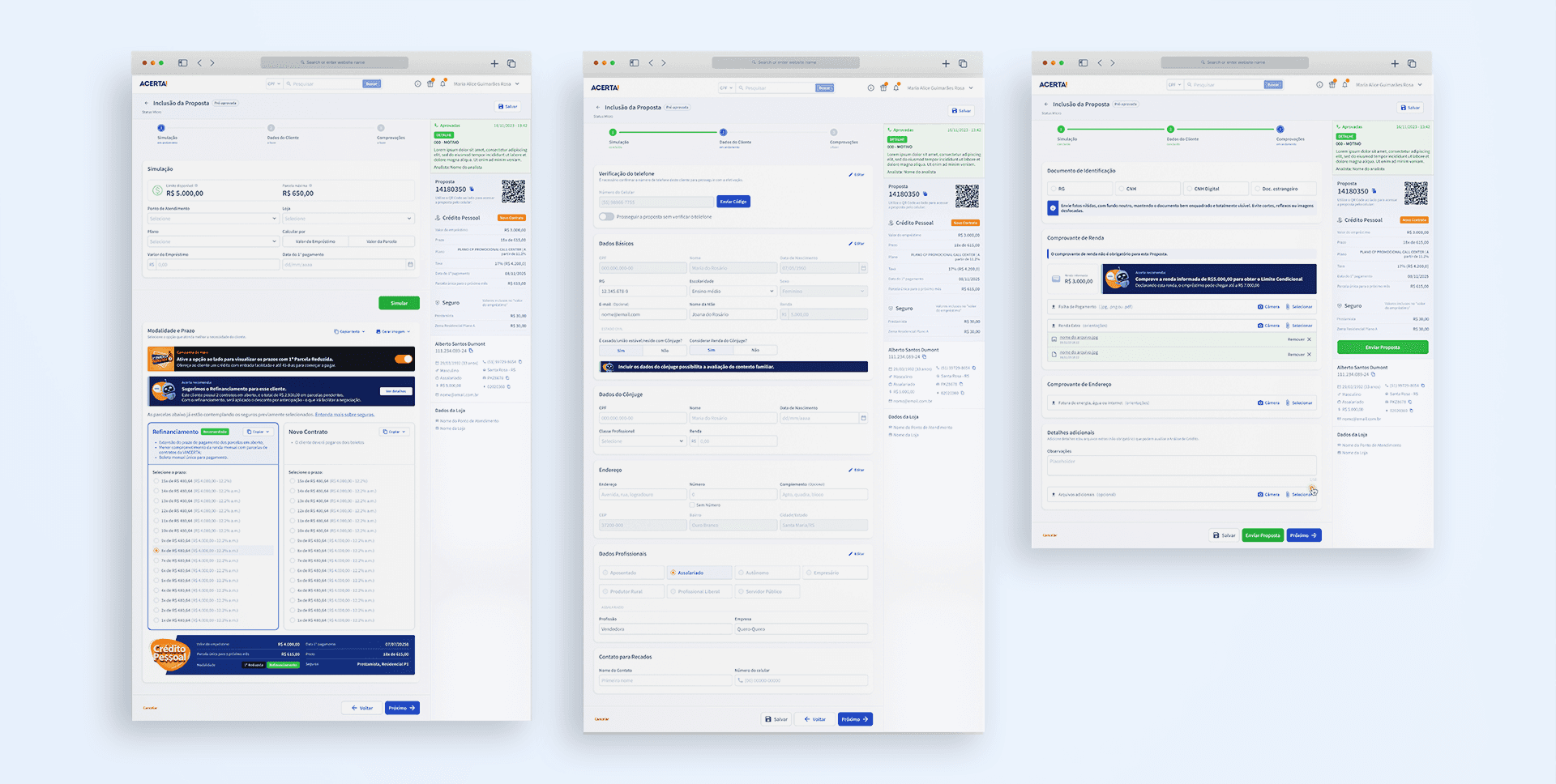
In a business-critical flow, innovation didn’t mean adding complexity. It meant reducing friction, creating a clearer experience, and building a reliable foundation for future evolution.
Context
Acerta is a financial services company specializing in microcredit for individuals, with nationwide operations and a network of branches primarily across Brazil’s South, Southeast, and Central-West regions.
Its portfolio includes credit products from multiple financial institutions, with a strong focus on products offered by Viacerta Financeira, which belongs to the same business group.
To support its operations, the company has an in-house Technology organization composed of Product, Design, and Engineering professionals responsible for building and evolving its digital platforms.
As a Product Designer and Design Tech Lead, I worked on establishing Design processes, building the new Design System, and redesigning several experiences across the Acerta platform.
After nearly a year with the company, I took ownership of redesigning the Proposal Flow, the core sales flow of the operation and one of the most business-critical areas of the entire platform.
The Challenges
Viacerta’s sales process is divided into three main stages: pre-proposal, proposal, and closing.
The proposal is one of the most extensive stages in the journey. This is where consultants formalize the customer’s intent to move forward, register their information, and gather the documents and supporting evidence required for the application to proceed to credit analysis.
The complexity increases because the flow supports multiple products — including Personal Loans, Secured Loans, Agricultural Credit, and Financing — as well as different customer profiles, each with its own business rules and requirements.
At the same time, users have significantly different levels of expertise. Consultants at Acerta branches and the Call Center use the platform daily and receive frequent training on Viacerta products. Banking correspondents are experienced with credit products but work across multiple financial institutions. Retail partners, on the other hand, use the platform with less familiarity with financial products.
The new flow needed to work effectively for all of them.
There was another critical factor: the Proposal Flow is directly tied to the company’s revenue generation. A critical usability issue, business-rule failure, or implementation error could disrupt sales and result in significant financial impact.
For this reason, the redesign could not be approached simply as a UI modernization effort. We needed to deeply understand the business, mitigate the risks associated with the transition, and ensure the new experience could support different products, scenarios, and user profiles.
The Approach
Given the business-critical nature of the flow, we structured a more extensive Discovery and Validation process than usual.
The goal was to understand not only the visible interface issues, but also the underlying business rules, technical dependencies, edge cases, and sources of rework throughout the process.
Discovery
Technical and Business Research
I started by mapping the as-is flow, identifying variations across products and customer profiles.
I also reconstructed the existing Information Architecture to understand which data was requested at each stage, what was mandatory, and what depended on specific product rules.
This assessment was complemented by multiple research streams:
Product: Workshops with Product Managers responsible for different credit products to understand their specific requirements, needs, and hypotheses.
Engineering: Assessment of the solution’s technical history, legacy constraints, requirements, proposal statuses, and the actions available in each scenario.
Business: Conversations with Credit Analysts, Consultants, and subject-matter experts to understand the main operational pain points and, in particular, the reasons proposals were being returned from credit analysis with pending requirements.
Design Analysis
The assessment revealed that the flow’s problems were not concentrated in a single area. Instead, they resulted from a combination of Information Architecture issues, technical constraints, missing capabilities, and inconsistencies accumulated over years of product evolution.
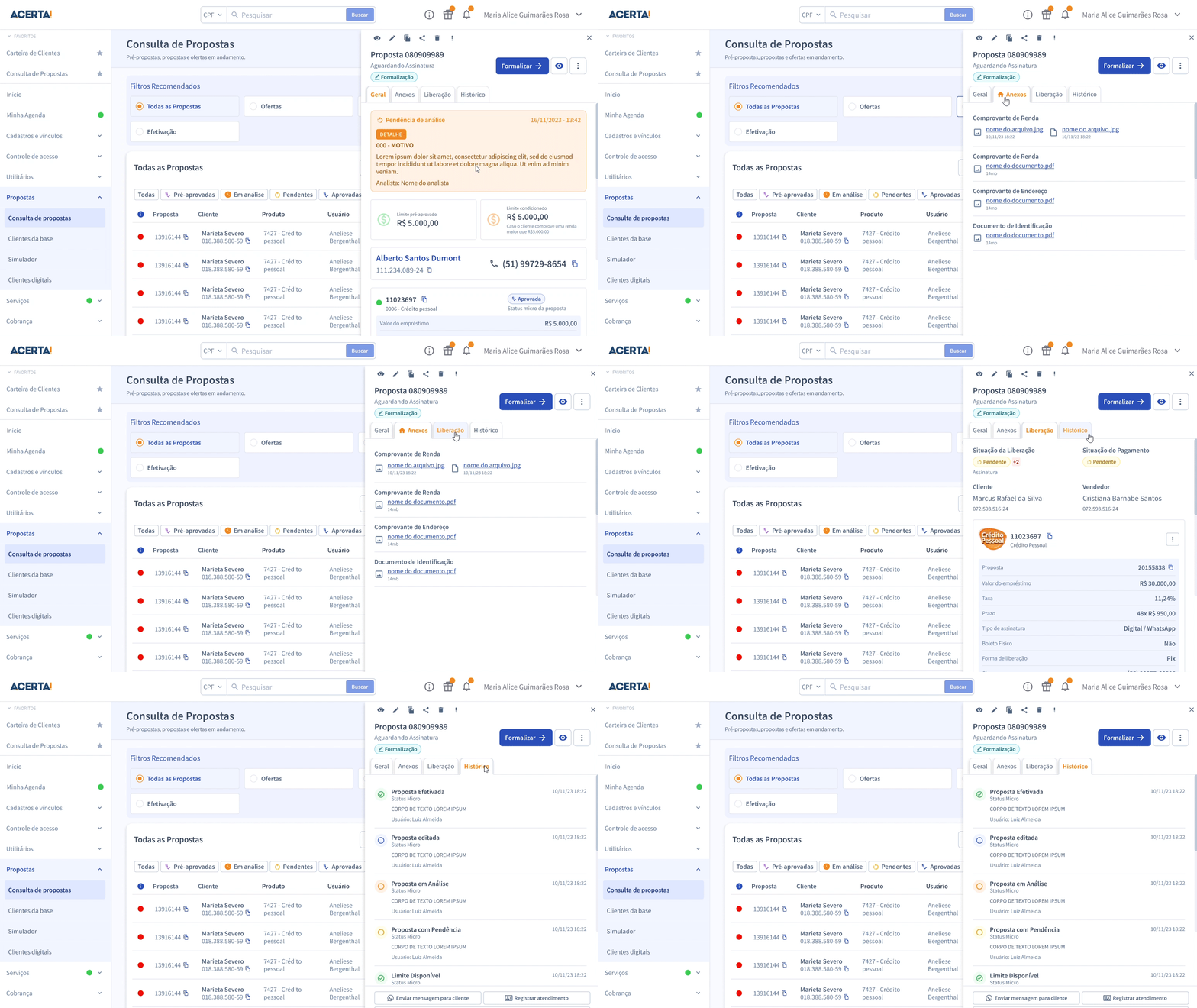
No dedicated view state: Proposals could only be accessed through a summarized list view or in edit mode. If users needed to review more detailed information, they had to enter the editing flow, unnecessarily increasing the risk of accidental changes.
Disorganized information: Although proposal creation was divided into stages, information related to the product, customer, and supporting documents was mixed together, making the process harder to understand.
Inconsistent experience: As a legacy system that had evolved over several years, different interaction and UI patterns coexisted within the same flow. Beyond visual inconsistencies, some smaller workflows — such as uploading supporting documents — required unnecessarily cumbersome interactions.
Internally, the flow even earned an affectionate nickname: Frankenstein.
Lack of guidance and unnecessary rework: The system did not clearly communicate which documents were required for each product. Consultants relied on training or, in some cases, learned through trial and error: a proposal would be submitted to the Credit Analysis team and later returned with instructions about the additional documents required.
This behavior directly contributed to one of the key operational issues identified during Discovery: the high volume of proposals being returned from credit analysis with pending requirements.
A lengthy task with no way to pause: Although creating a proposal depended on information and documents provided by the customer, users could not save their progress.
Consultants had to keep the session open until the process was complete — particularly problematic for remote interactions, where customers could take longer to provide the required documentation.
Information overload: The application also requested information that was not always relevant to the selected product or customer profile, increasing cognitive load and the time required to complete a proposal.
The Solution
Discovery surfaced several opportunities to evolve the experience, including more experimental approaches such as gamification.
However, there was an important constraint: in addition to being a business-critical flow, the existing solution was built on legacy code and would require a substantial rebuild by Engineering. In this context, I made a deliberate prioritization decision.
Rather than introducing additional layers of complexity, I proposed a first version centered around getting the fundamentals right: an organized, functional, intuitive flow built on top of the new Design System.
The strategy was to address the fundamental experience issues first while establishing a component-based architecture. Once this foundation was in production, future improvements could be delivered with less effort and lower risk for both Design and Engineering.
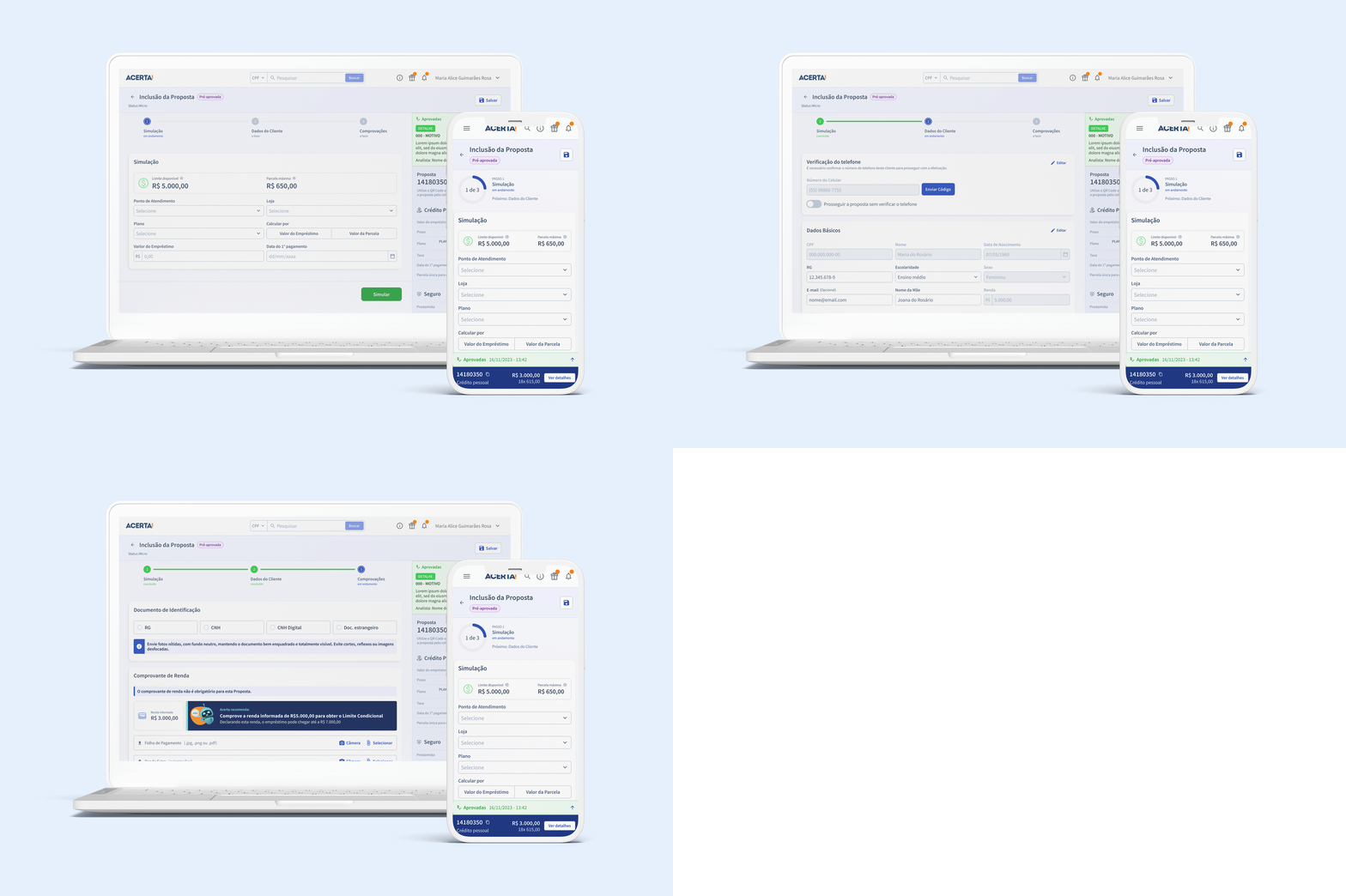
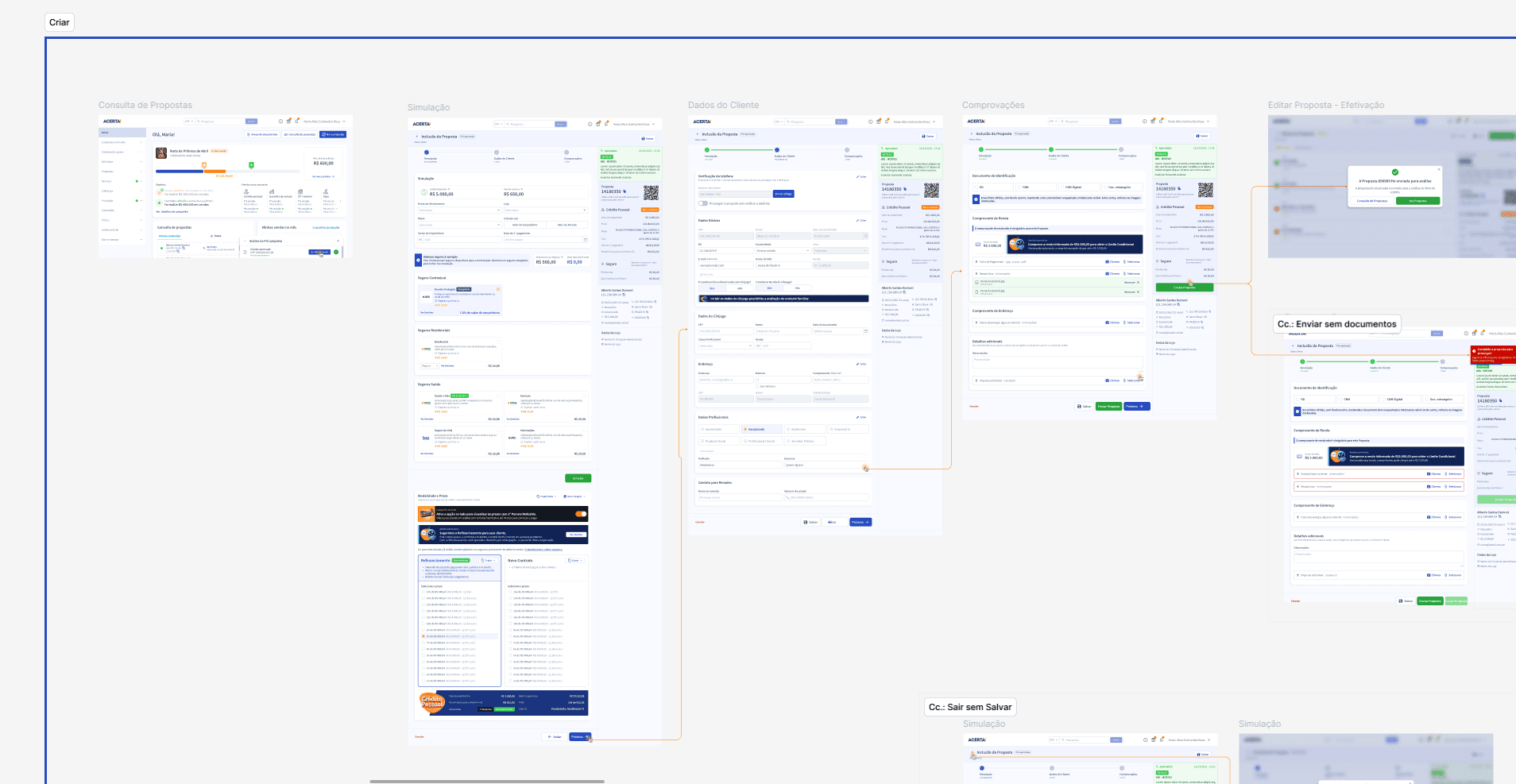
Consistency and organization: The new flow was built entirely using components from the Design System. The Information Architecture was also reorganized around the user’s mental model of the task, dividing the process into three clear stages: Simulation → Customer Information → Supporting Documents
Critical information always accessible: Key proposal information — including the selected product, customer, branch, and feedback from credit analysis — remains visible throughout the process through a sidebar summary. This allows consultants to access important information without losing context or leaving their current task.
Modularity and flexibility: Customer data was organized into modular, thematic containers that can be displayed or hidden according to each product’s business rules.
Spouse information, for example, is displayed only when the spouse’s income will be included in the credit assessment. Similarly, vehicle documentation is requested only when the selected product is a vehicle-secured loan. As a result, the interface adapts to the context of each proposal rather than exposing every possible field and requirement to every user.
User control and freedom: We introduced the ability to save a proposal in progress. In addition to reducing the risk of losing previously entered information, this allowed consultants to pause an application while waiting for customer documents and resume it later. For teams such as the Call Center, this also made it possible to switch between multiple customer interactions without losing progress.
Progressive Disclosure: Proposal details became accessible at different levels of depth depending on the user’s needs. The familiar proposal list was preserved and enhanced with filters that more accurately identify each proposal’s current stage. A drawer provides a quick overview of the selected product, customer information, and any outstanding requirements. When a more detailed review is needed, a dedicated page allows users to access all proposal information and supporting documents without entering edit mode. This enables users to access the right level of information for each context without overloading simpler interactions.
Delivery
Validation with Users and Stakeholders
Given the risk involved in replacing a flow directly tied to the company’s sales operation, the solution was validated at multiple levels.
Each validation round generated new improvement opportunities, which were documented and incorporated into the prototype before moving to the next stage.
Technical Validation
The complete flow was reviewed with Product, Front-end, Back-end, QA, and Infrastructure teams.
In addition to assessing technical feasibility, I explicitly asked the team to identify edge cases I might not have captured from a Design perspective, leveraging their technical expertise and historical knowledge of the platform to reduce implementation risks.
Business Validation
Managers and specialists from the Sales team, along with professionals from the Credit Analysis team, also participated in the validation process. The goal was to ensure that the proposed structure addressed the operational pain points identified during Discovery while remaining aligned with business rules.
User Validation
Using an interactive prototype, I conducted usability testing with consultants responsible for creating proposals. Recruitment was designed to reflect the actual diversity of the platform’s users, considering age group, level of experience, and point-of-sale type, including Acerta branches, Call Center consultants, banking correspondents, and retail partners.
During the sessions, participants were asked to create a complete proposal while I observed their behavior, difficulties, and points of friction. Users were able to navigate and complete the new flow without blockers or critical usability issues.
Despite these positive results, we conducted a second, smaller validation round using the implemented flow in the staging environment. The results reinforced the findings from the first round and gave the team greater confidence to move forward with the launch.
Progressive Rollout
Rather than replacing the legacy flow across the entire operation at once, we adopted a progressive rollout strategy. The new experience was initially released to a limited group of Acerta branches, allowing us to monitor the flow in production and collect feedback before expanding adoption.
Only a small number of UI and UX issues were reported, most of them related to microcopy adjustments. After the first few weeks of monitoring and refinement, the new Proposal Flow was rolled out across the entire operation.



Results and Learning
The new Proposal Flow replaced the legacy experience and became part of the Acerta platform's core operations.
User feedback after launch reinforced results observed during testing: the process came to be perceived as more organized and the interface as more intuitive.
Beyond modernizing the interface, the project established a new foundation for evolving one of Viacerta's most important flows.
The modular architecture, Design System adoption, and technical reconstruction created the conditions for future improvements to be incorporated with greater consistency and reduced complexity.
"Trabalhei diretamente com a Ana Emília enquanto liderava o time em que ela atuava como Product Designer. Ela chegou em um momento em que design ainda era uma disciplina incipiente na empresa e foi responsável por estruturar uma base sólida para a área, desde design ops até uma experiência de uso consistente na nossa plataforma de vendas, passando pelo lançamento de novos produtos com entrega de valor direta ao cliente final.
A qualidade técnica da entrega dela é de altíssimo nível e ela tem a capacidade de elevar a régua de qualquer time em que atua."

Nícolas Tischler
Product Manager


