
Proposal Flow Redesign
End-to-end redesign of Viacerta Financeira's primary commercial flow, balancing the needs of users with varying experience levels, complex business rules, and the risks involved in modernizing a legacy system.
Customer
VIACERTA Financeira
Categories
Product Design
Duration
3 months
My Role
Product Design
Tools
Figma
Team
Product Design; Product Managers; Engineering
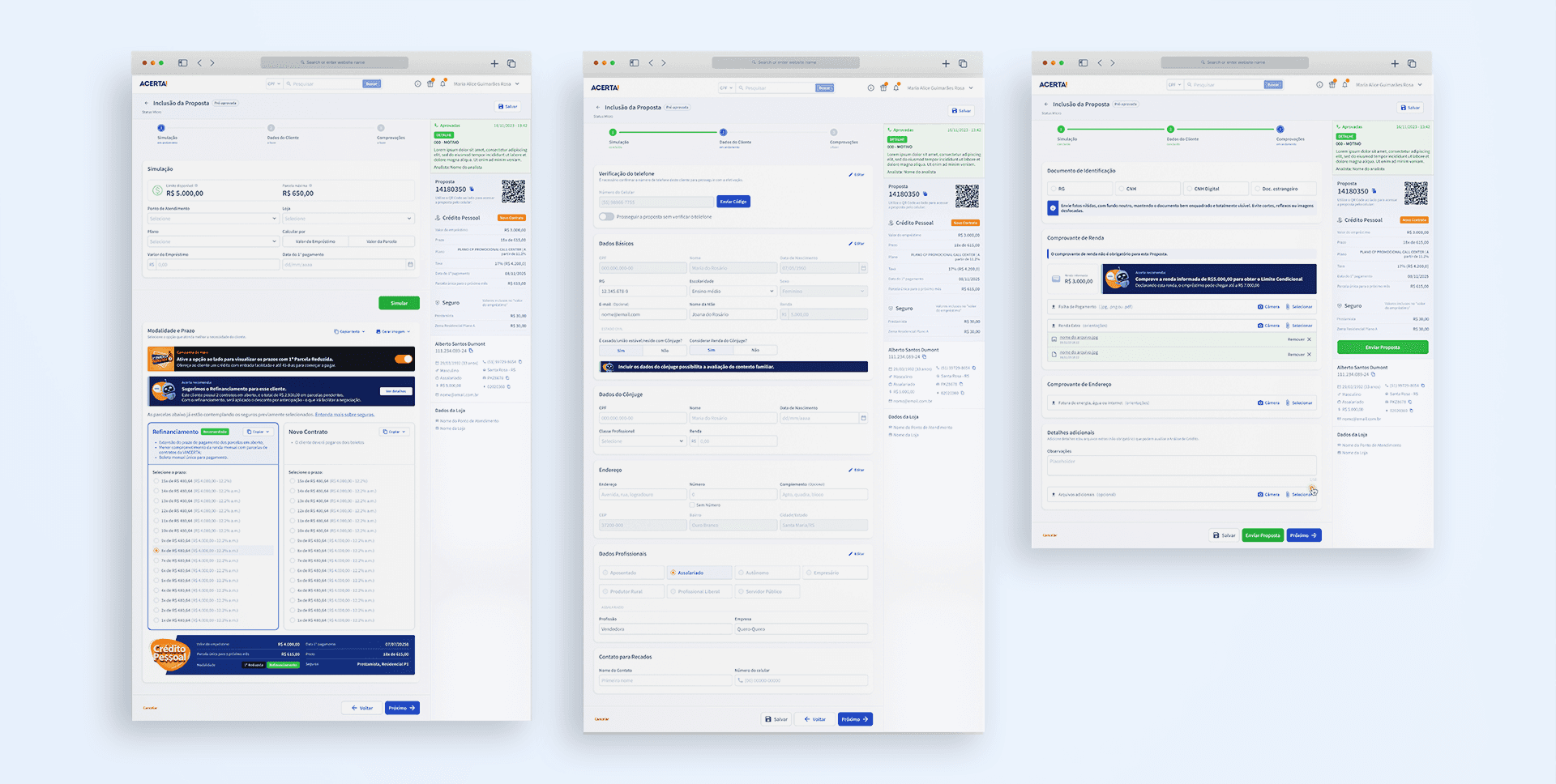
In a business-critical flow, innovation didn’t mean adding complexity. It meant reducing friction, creating a clearer experience, and building a reliable foundation for future evolution.
Context
Acerta is a financial services company specializing in microcredit for individuals, with nationwide operations and a network of branches primarily across Brazil’s South, Southeast, and Central-West regions.
Its portfolio includes credit products from multiple financial institutions, with a strong focus on products offered by Viacerta Financeira, which belongs to the same business group.
To support its operations, the company has an in-house Technology organization composed of Product, Design, and Engineering professionals responsible for building and evolving its digital platforms.
As a Product Designer and Design Tech Lead, I worked on establishing Design processes, building the new Design System, and redesigning several experiences across the Acerta platform.
After nearly a year with the company, I took ownership of redesigning the Proposal Flow, the core sales flow of the operation and one of the most business-critical areas of the entire platform.
The Challenges
Viacerta’s sales process is divided into three main stages: pre-proposal, proposal, and closing.
The proposal is one of the most extensive stages in the journey. This is where consultants formalize the customer’s intent to move forward, register their information, and gather the documents and supporting evidence required for the application to proceed to credit analysis.
The complexity increases because the flow supports multiple products — including Personal Loans, Secured Loans, Agricultural Credit, and Financing — as well as different customer profiles, each with its own business rules and requirements.
At the same time, users have significantly different levels of expertise. Consultants at Acerta branches and the Call Center use the platform daily and receive frequent training on Viacerta products. Banking correspondents are experienced with credit products but work across multiple financial institutions. Retail partners, on the other hand, use the platform with less familiarity with financial products.
The new flow needed to work effectively for all of them.
There was another critical factor: the Proposal Flow is directly tied to the company’s revenue generation. A critical usability issue, business-rule failure, or implementation error could disrupt sales and result in significant financial impact.
For this reason, the redesign could not be approached simply as a UI modernization effort. We needed to deeply understand the business, mitigate the risks associated with the transition, and ensure the new experience could support different products, scenarios, and user profiles.
The Approach
Given the business-critical nature of the flow, we structured a more extensive Discovery and Validation process than usual.
The goal was to understand not only the visible interface issues, but also the underlying business rules, technical dependencies, edge cases, and sources of rework throughout the process.
Discovery
Technical and Business Research
I started by mapping the as-is flow, identifying variations across products and customer profiles.
I also reconstructed the existing Information Architecture to understand which data was requested at each stage, what was mandatory, and what depended on specific product rules.
This assessment was complemented by multiple research streams:
Product: Workshops with Product Managers responsible for different credit products to understand their specific requirements, needs, and hypotheses.
Engineering: Assessment of the solution’s technical history, legacy constraints, requirements, proposal statuses, and the actions available in each scenario.
Business: Conversations with Credit Analysts, Consultants, and subject-matter experts to understand the main operational pain points and, in particular, the reasons proposals were being returned from credit analysis with pending requirements.
Design Analysis
The assessment revealed that the flow’s problems were not concentrated in a single area. Instead, they resulted from a combination of Information Architecture issues, technical constraints, missing capabilities, and inconsistencies accumulated over years of product evolution.
No dedicated view state: Proposals could only be accessed through a summarized list view or in edit mode. If users needed to review more detailed information, they had to enter the editing flow, unnecessarily increasing the risk of accidental changes.
Disorganized information: Although proposal creation was divided into stages, information related to the product, customer, and supporting documents was mixed together, making the process harder to understand.
Inconsistent experience: As a legacy system that had evolved over several years, different interaction and UI patterns coexisted within the same flow. Beyond visual inconsistencies, some smaller workflows — such as uploading supporting documents — required unnecessarily cumbersome interactions.
Internally, the flow even earned an affectionate nickname: Frankenstein.
Lack of guidance and unnecessary rework: The system did not clearly communicate which documents were required for each product. Consultants relied on training or, in some cases, learned through trial and error: a proposal would be submitted to the Credit Analysis team and later returned with instructions about the additional documents required.
This behavior directly contributed to one of the key operational issues identified during Discovery: the high volume of proposals being returned from credit analysis with pending requirements.
A lengthy task with no way to pause: Although creating a proposal depended on information and documents provided by the customer, users could not save their progress.
Consultants had to keep the session open until the process was complete — particularly problematic for remote interactions, where customers could take longer to provide the required documentation.
Information overload: The application also requested information that was not always relevant to the selected product or customer profile, increasing cognitive load and the time required to complete a proposal.
The Solution
A etapa de descoberta revelou diversas oportunidades para evoluir a experiência, incluindo abordagens mais experimentais, como a gamificação.
No entanto, havia uma restrição importante: além de ser um fluxo crítico para o negócio, a solução existente foi construída em código legado e exigiria uma reconstrução substancial por parte da Engenharia. Diante disso, tomei uma decisão consciente de priorização.
Em vez de introduzir camadas adicionais de complexidade, propus uma primeira versão focada em garantir que os fundamentos estivessem corretos: um fluxo organizado, funcional e intuitivo, construído com base no novo Design System.
A estratégia foi resolver os problemas fundamentais de experiência primeiro, enquanto estabelecíamos uma arquitetura baseada em componentes. Uma vez que essa base estivesse em produção, melhorias futuras poderiam ser entregues com menos esforço e menor risco tanto para o Design quanto para a Engenharia.
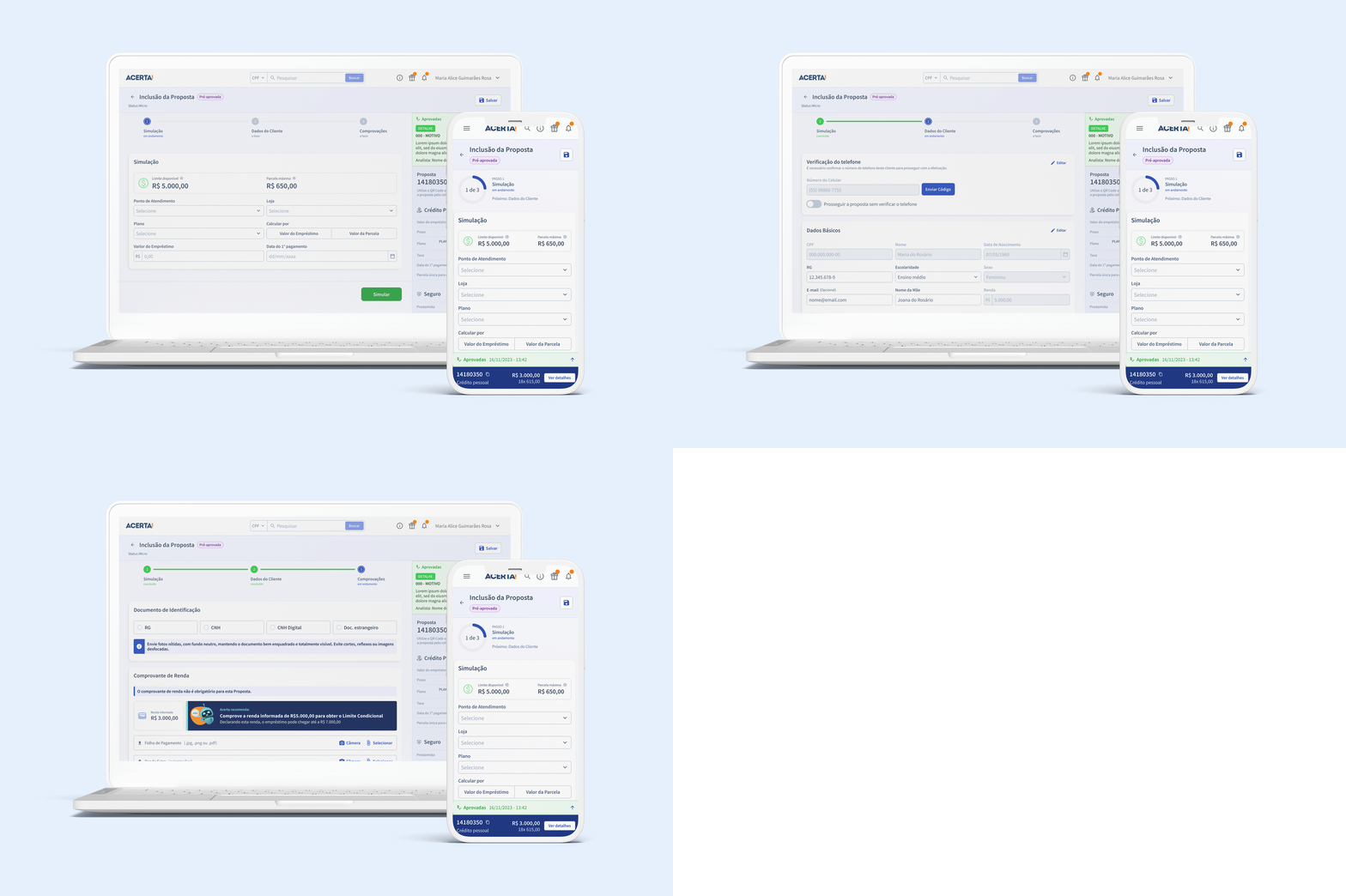
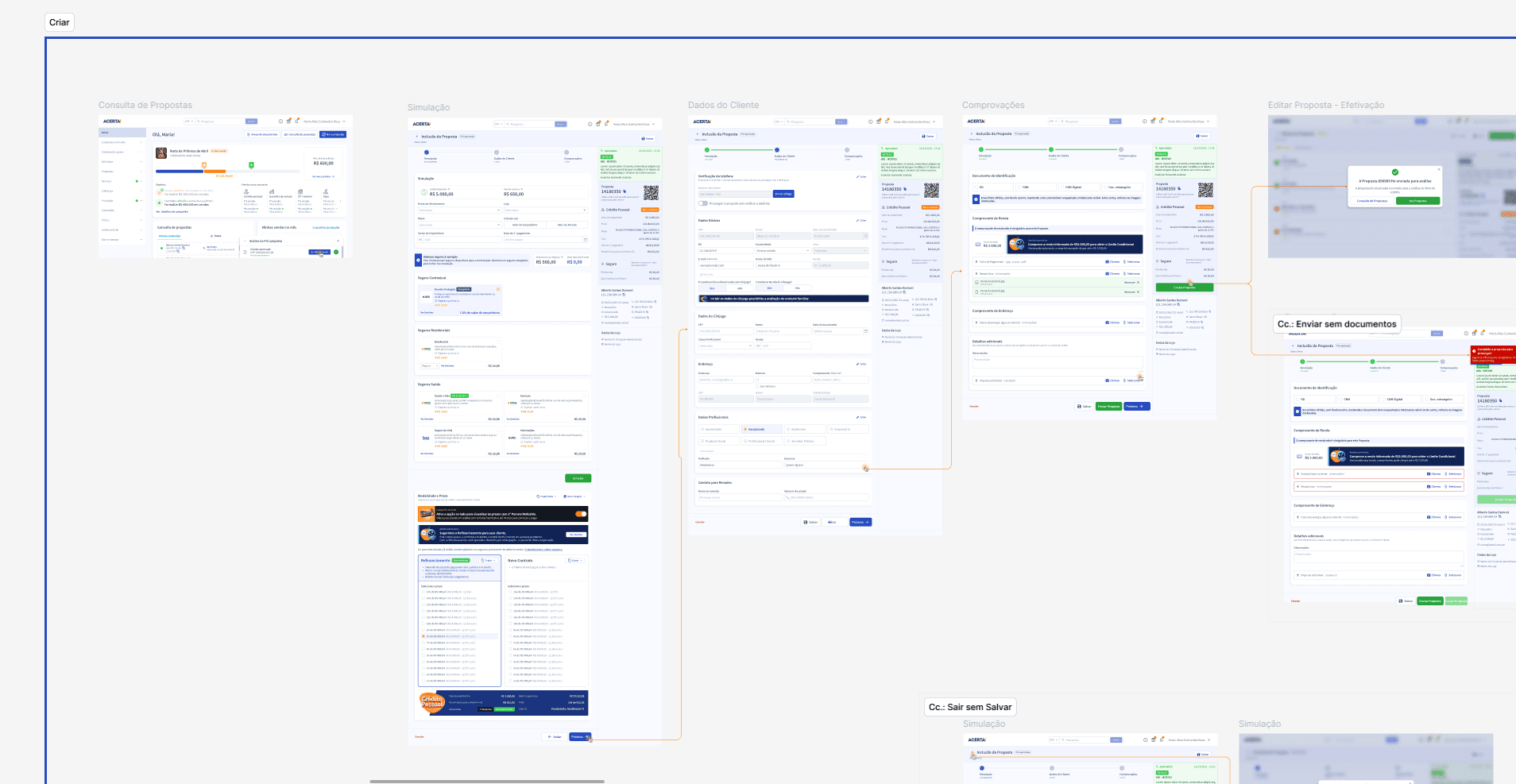
Consistência e organização: O novo fluxo foi totalmente construído utilizando componentes do Design System. A Arquitetura de Informação também foi reorganizada em torno do modelo mental do usuário para a tarefa, dividindo o processo em três etapas claras: Simulação → Dados do Cliente → Documentos Comprobatórios
Informações críticas sempre acessíveis: As principais informações da proposta — incluindo o produto selecionado, cliente, filial e o retorno da análise de crédito — permanecem visíveis durante todo o processo através de um resumo na barra lateral. Isso permite que os consultores acessem dados importantes sem perder o contexto ou abandonar a tarefa atual.
Modularidade e flexibilidade: Os dados do cliente foram organizados em blocos modulares e temáticos que podem ser exibidos ou ocultados de acordo com as regras de negócio de cada produto.
As informações do cônjuge, por exemplo, são exibidas apenas quando a renda do parceiro for incluída na avaliação de crédito. Da mesma forma, a documentação do veículo é solicitada apenas quando o produto selecionado for um empréstimo com garantia de veículo. Como resultado, a interface se adapta ao contexto de cada proposta em vez de expor todos os campos e requisitos possíveis para todos os usuários.
Controle e liberdade do usuário: Introduzimos a funcionalidade de salvar uma proposta em andamento. Além de reduzir o risco de perda de informações já preenchidas, isso permitiu que os consultores pausassem uma solicitação enquanto aguardavam os documentos do cliente e a retomassem mais tarde. Para equipes como as do Call Center, isso também possibilitou alternar entre múltiplos atendimentos sem perder o progresso.
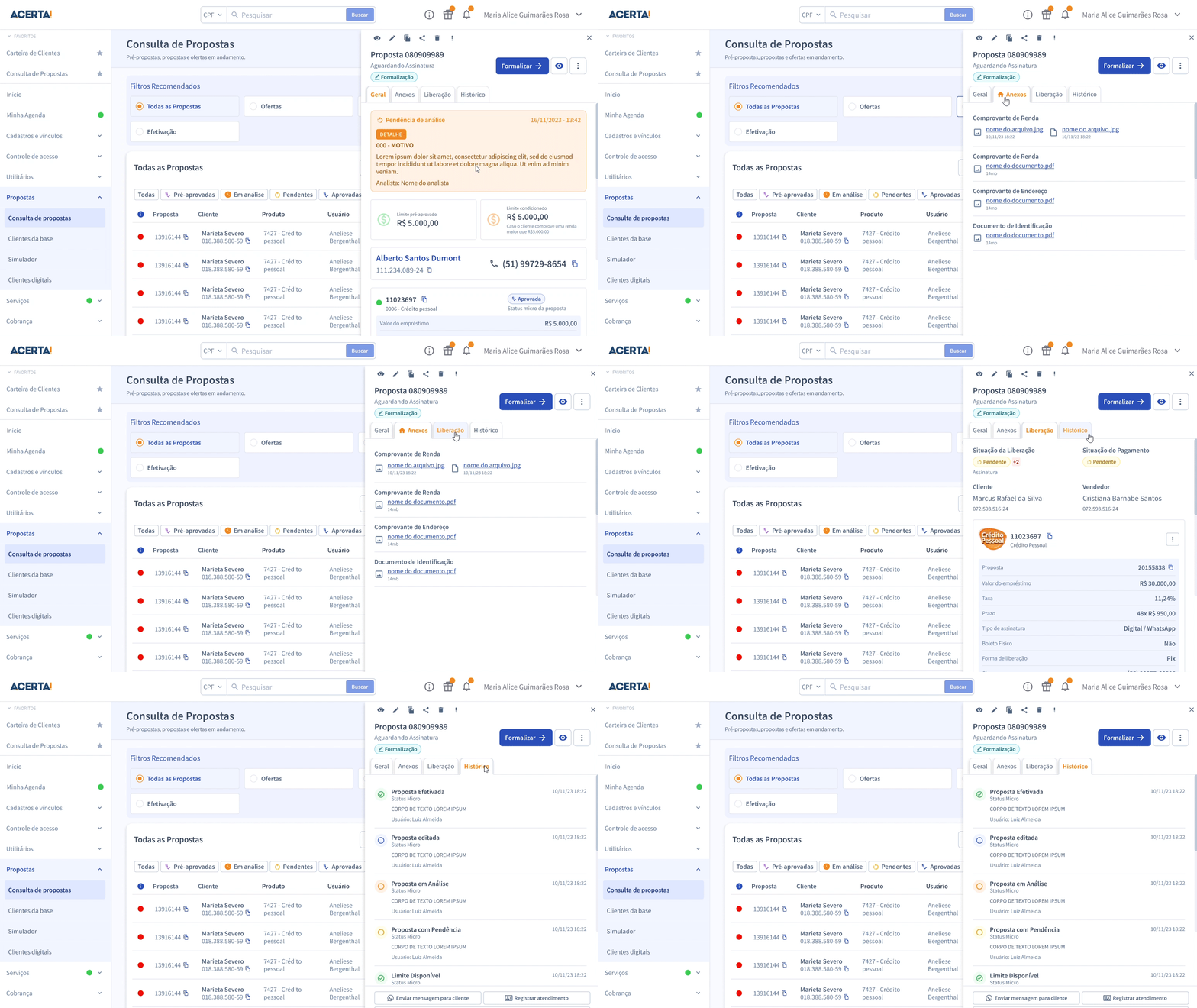
Divulgação Progressiva (Progressive Disclosure): Os detalhes da proposta passaram a ser acessíveis em diferentes níveis de profundidade, dependendo da necessidade do usuário. A lista de propostas, já familiar, foi preservada e aprimorada com filtros que identificam com maior precisão a etapa atual de cada proposta. Um painel lateral (drawer) oferece uma visão rápida do produto selecionado, dados do cliente e eventuais pendências. Quando é necessária uma análise detalhada, uma página dedicada permite acessar todas as informações da proposta e documentos comprobatórios sem precisar entrar no modo de edição. Isso possibilita que os usuários acessem o nível certo de informação para cada contexto sem sobrecarregar as interações mais simples.
Delivery
Validation with Users and Stakeholders
Dado o risco envolvido na substituição de um fluxo diretamente atrelado à operação de vendas da empresa, a solução foi validada em múltiplos níveis.
Cada rodada de validação gerou novas oportunidades de melhoria, que foram documentadas e incorporadas ao protótipo antes de avançar para a próxima etapa.
Validação Técnica
O fluxo completo foi revisado com as equipes de Produto, Front-end, Back-end, QA e Infraestrutura.
Além de avaliar a viabilidade técnica, pedi explicitamente à equipe para identificar casos extremos (edge cases) que eu pudesse não ter capturado sob a perspectiva de Design, aproveitando a expertise técnica e o histórico deles na plataforma para reduzir os riscos de implementação.
Validação de Negócios
Gerentes e especialistas da equipe de Vendas, juntamente com profissionais da equipe de Análise de Crédito, também participaram do processo de validação. O objetivo era garantir que a estrutura proposta resolvesse as dores operacionais identificadas durante o Discovery, mantendo-se alinhada às regras de negócio.
Validação com o Usuário
Utilizando um protótipo interativo, realizei testes de usabilidade com consultores responsáveis pela criação de propostas. O recrutamento foi planejado para refletir a diversidade real dos usuários da plataforma, considerando faixa etária, nível de experiência e tipo de ponto de venda, incluindo filiais da Acerta, consultores de Call Center, correspondentes bancários e parceiros de varejo.
Durante as sessões, os participantes foram orientados a criar uma proposta completa enquanto eu observava seu comportamento, dificuldades e pontos de atrito. Os usuários conseguiram navegar e concluir o novo fluxo sem bloqueios ou problemas críticos de usabilidade.
Apesar desses resultados positivos, realizamos uma segunda rodada menor de validação utilizando o fluxo implementado no ambiente de homologação. Os resultados reforçaram as descobertas da primeira rodada e deram à equipe maior segurança para prosseguir com o lançamento.
Rollout Progressivo
Em vez de substituir o fluxo legado em toda a operação de uma só vez, adotamos uma estratégia de rollout progressivo. A nova experiência foi lançada inicialmente para um grupo limitado de filiais da Acerta, permitindo-nos monitorar o fluxo em produção e coletar feedbacks antes de expandir a adoção.
Apenas um pequeno número de problemas de UI e UX foi reportado, a maioria relacionada a ajustes de microcopy. Após as primeiras semanas de monitoramento e refinamento, o novo Fluxo de Propostas foi disponibilizado para toda a operação.



Results and Learning
The new Proposal Flow replaced the legacy experience and became part of the Acerta platform's core operations.
User feedback after launch reinforced results observed during testing: the process came to be perceived as more organized and the interface as more intuitive.
Beyond modernizing the interface, the project established a new foundation for evolving one of Viacerta's most important flows.
The modular architecture, Design System adoption, and technical reconstruction created the conditions for future improvements to be incorporated with greater consistency and reduced complexity.
"I had the opportunity to lead the team where Ana Emília worked as a Product Designer. She joined the company at a time when Design was still in its early stages and was instrumental in establishing a strong foundation for the discipline. Her contributions ranged from implementing DesignOps practices and creating a consistent user experience across our sales platform to launching new products that delivered real value to our customers.
Ana's technical expertise is outstanding, and she has a remarkable ability to elevate the quality, maturity, and impact of every team she works with."

Nícolas Tischler
Product Manager


